


A Technical Guide Based on SOR and SLR: How to Select Lamella Clarifiers
A Technical Guide Based on SOR and SLR: How to Select Lamella Clarifiers
Lamella clarifiers, also known as inclined plate settlers (IPS), are a cornerstone technology for high-rate Solid-Liquid Separation. Their compact footprint - typically 10 - 20% that of conventional clarifiers - makes them attractive across industries. However, successful selection requires more than just plugging numbers into an area equation. Engineers must balance two critical parameters: Surface Overflow Rate (SOR) and Solids Loading Rate (SLR).
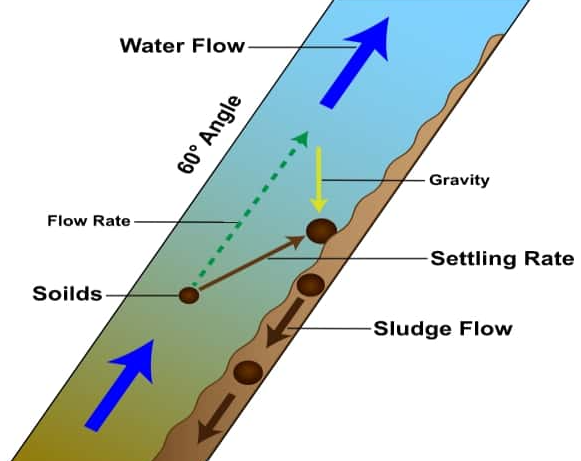
The Two Key Parameters
- Surface Overflow Rate (SOR)
SOR measures hydraulic loading. It is calculated as flow rate divided by effective settling area (typically the horizontal projected area or total plate area, depending on the manufacturer). Units are usually m³/m²·h (m/h) or gpm/ft².
• Higher SOR → smaller footprint, but higher risk of poor settling if particles are light or flocs are fragile.
• Lamella systems typically operate at 10–25 m/h, compared to 1–3 m/h for conventional clarifiers.
- Solids Loading Rate (SLR)
SLR measures the mass of solids applied per unit area per time. It is calculated as (flow X influent TSS) / area, with units of kg/m²·h or lb/ft²·day.
• SLR becomes critical when influent Suspended Solids (TSS) are high. Excessive SLR can cause plate fouling, sludge blanket formation, or solids carryover.
• Most lamella designs handle 5 - 12 kg/m²·h, though this varies with particle characteristics.
General Selection Workflow
- Determine design flow (average and peak) and influent TSS.
- Select conservative SOR/SLR based on your specific wastewater characteristics (particle density, settleability, floc strength, oil/grease, scaling potential, etc.).
- Calculate required effective plate area as Area = Q / SOR, then cross-check SLR = (Q X TSS) / Area.
- Consider mechanical design: plate spacing (typically 50 - 80 mm), inclination (45 - 60°), materials (stainless steel, FRP, PVC), and fouling risk.
- Apply safety factors (10 - 20%) for peak flows, cold water (which slows settling), and variable loads.
Industry-Specific SOR and SLR Guidelines
1. Municipal Wastewater - Primary Clarification
TSS: 100–300 mg/L (good settleability with coagulation)
SOR: 10–20 m/h (higher for well-flocculated water)
SLR: 5–10 kg/m²·h
Key focus: Hydraulic capacity is often limiting; use lower rates without chemicals.
2. Municipal - Secondary Clarification (after activated sludge)
TSS: 2,000–4,000 mg/L MLSS (lower to clarifier), light biological flocs
SOR: 8–15 m/h (more conservative due to floc fragility)
SLR: 4–8 kg/m²·h (up to 10–12 in high-rate designs)
Key focus: SLR usually controls to prevent solids washout.
3. Mining & Mineral Processing
TSS: Often >1,000 mg/L, heavy inorganic particles (sand, silt, metal hydroxides)
SOR: 15–25 m/h (higher for coarse particles)
SLR: 8–15+ kg/m²·h
Key focus: SLR often governs; use corrosion-resistant materials.
4. Metal Finishing, Electroplating & Steel (Mill Scale)
TSS: Metal hydroxides, oils, heavy metals - often sticky or scaling-prone
SOR: 10–18 m/h
SLR: 5–10 kg/m²·h
Key focus: Lower rates prevent fouling; choose easy-to-clean designs or wider spacing.
5. Chemical, Pharmaceutical & Petrochemical
TSS: Variable - fine precipitates, emulsions, organic solids
SOR: 8–15 m/h
SLR: 4–9 kg/m²·h
Key focus: Pilot testing strongly recommended; chevron plates aid sludge sliding.
6. Food & Beverage Processing (Dairy, Meat, Beverage)
TSS: High organic TSS, fats/oils/grease (FOG)
SOR: 10–18 m/h
SLR: 5–12 kg/m²·h
Key focus: Pre-remove FOG (e.g., with DAF) before lamella; SLR limits during production peaks.
7. Pulp & Paper
TSS: Fibers, fillers, sticky components
SOR: 12–20 m/h
SLR: 6–12 kg/m²·h
Key focus: Fibrous solids may bridge plates; use wider spacing or special profiles.
8. Textile & Dyeing
TSS: Fine colored particles, chemicals – poor natural settleability
SOR: 8–14 m/h (requires good coagulation/flocculation)
SLR: 4–8 kg/m²·h
Key focus: Conservative rates; color removal needs enhanced flocculation.
Practical Selection Steps
- Characterize your wastewater - Measure TSS, run jar tests, assess particle density, pH, temperature, oil/grease, and scaling potential.
- Apply design rates - Start with the ranges above. Use lower SOR/SLR for light/flocculent solids, cold water, or high variability. Use higher rates for dense, inorganic, well-flocculated solids.
- Calculate required area - A ≈ Q / SOR. Verify that SLR stays within limits based on actual TSS.
- Account for site factors - Peak flow factors, footprint constraints, sludge handling, material compatibility, and maintenance access.
- Pilot when uncertain - For industrial applications with variable chemistry, pilot testing is strongly recommended.
Note: Always confirm whether the manufacturer rates capacity on horizontal projected area or total plate surface area. This directly affects your SOR calculation.